
(Spoiler: It might be $0)
I’ve been trading futures for almost 30 years. When I started, the contracts were 10 to 50 times bigger than what’s available today. There were no mini contracts, no micro contracts, and certainly no prop programs. If you wanted to trade, you deposited your own money and accepted all the risk that came with it.
I went through a series of $5,000 real-money accounts in those early years. Like most traders, I lost them. Multiple times.
So when people ask me, “How much do I need to start trading futures?” my honest answer today is very different from what it would have been even 5 years ago. Because the landscape has completely changed, and most people don’t know it yet.
The Short Answer: You May Not Need Any Money At All
This isn’t clickbait. Thanks to the rise of futures prop funding programs, it’s now genuinely possible to start trading futures without depositing a single dollar of your own capital.
These programs give you access to a simulated trading account, provided by the firm, in exchange for a small subscription or one-time evaluation fee. If you trade that account profitably within their rules, you get “funded,” usually still with a demo account but one where you are able to start earning a share of the profits.
Top Step Trader pioneered this concept around 2013–2014. Since then, the space has exploded. There are now over 50 futures funding firms operating, and the competition has driven costs down significantly.
For most beginners today, a prop program is the right starting point. Period.
How Prop Programs Actually Work
Before you sign up for one, let me save you from a common misunderstanding.
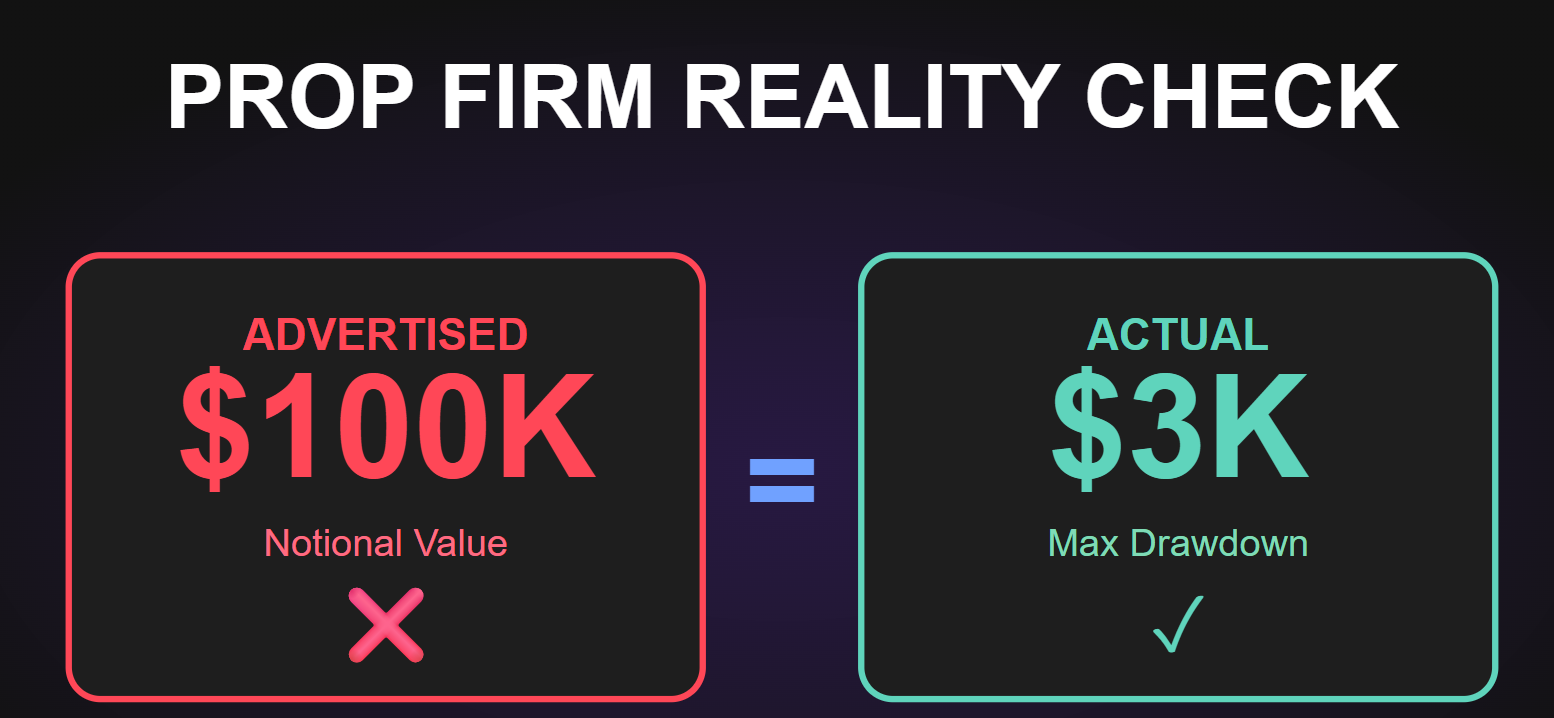
Prop programs market themselves using notional account values: $25,000, $50,000, $100,000. These numbers sound impressive, but they can be misleading. The number that actually matters is the total drawdown — that’s the real size of your risk buffer.
For most beginner-level accounts, here’s what the math looks like:
| Notional Account Size | Typical Total Drawdown |
|---|---|
| $25,000 | ~$1,250–$1,500 |
| $50,000 | ~$2,000–$2,500 |
| $100,000 | ~$3,000–$5,000 |
That drawdown is your actual working capital in the simulation. Think of it less like a $50,000 account and more like a $2,500 account with strict rules. When you understand it that way, you’ll trade it with the right respect.
The Path from Evaluation to Payout
Here’s how the journey typically works:
- Evaluation phase. You trade a demo account and must meet profit targets while staying within drawdown limits. You pay a monthly or one-time subscription fee during this phase.
- Activation. Once you pass, you pay a one-time activation fee to unlock your funded account.
- Funded account. Now you’re trading a simulated account where a portion of your profits are “real” and can be withdrawn.
Some programs also offer free retries, resets, or multiple account sizes. The key is to shop around and read the fine print.
Programs Worth Looking At
There are dozens of options. The ones I most commonly point traders toward, especially beginners, are:
- Apex Trader Funding
- Take Profit Trader
- Top Step Trader
- Tradeify
- My Funded Futures
- Earn2Trade
- Bulenox
- And many others. See the Futures Fanatic YouTube community posts for the latest on prop firms.
For most people just starting out, I recommend Apex Trader Funding or Take Profit Trader, and specifically their end-of-day accounts. With end-of-day accounts, your drawdown is calculated based on your closing balance, not your intraday high, which gives you more breathing room and rewards disciplined trading.
Passing Is Just The First Step
Here’s something most prop program articles won’t tell you: getting funded is not the finish line.
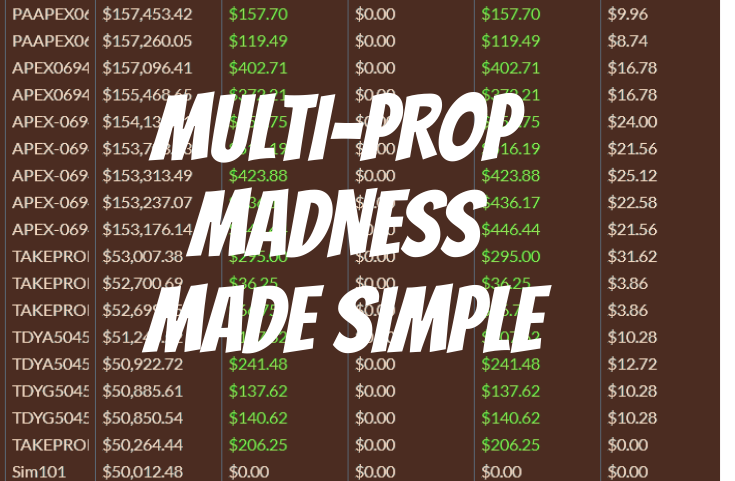
I’ve worked with thousands of traders who’ve used our methods and frameworks to pass prop program evaluations. And yes, passing is great. But I’ve seen just as many traders blow their funded accounts before ever taking a payout. They passed using too much leverage, and then kept using too much leverage in their funded account.
The goal isn’t to pass. The goal is to pass using sizing and risk management strategies that are appropriate for small accounts, because that’s what prop programs are. Small accounts with strict rules.
One of the most important concepts we teach at TDG is the Daily Risk Budget (DRB) — a hard daily loss limit you set before the session starts and never violate. It sounds simple. Most traders ignore it anyway. The ones who stick with it are the ones still trading a year later. Here’s a deep dive on the DRB if you want to go further.
When traders come through our trade room, the shift usually happens within about 90 days. Whether they’re brand new to trading or stuck in a vicious cycle of passing and blowing up without ever taking a payout, it’s the risk management piece, not the strategy, that breaks the pattern.
What If You Want To Fund You Own Account?
Not everyone wants to go the prop route, and that’s fine. Maybe you’ve already been funded and want to trade independently. Maybe you prefer the freedom of trading without evaluation rules.
If you’re going to trade with your own capital, here’s my guidance:
Start with the smallest products available. That means micro futures, specifically the MYM (Micro E-mini Dow Jones). At roughly $0.50 per tick, the MYM gives you real market exposure with dramatically lower risk per contract than larger products like the ES or NQ.
For proper capitalization trading a small number of MYM contracts, I’d suggest a minimum of $2,500 to $5,000.
To verify the right account size for any futures product, go directly to the CME Group website and look up the initial margin and maintenance margin requirements for the contract you want to trade. That’s the authoritative source, not your broker’s requirements.
A quick word on day trader margins: many futures brokers offer intraday margins that are a fraction of the actual cost to hold a position, sometimes one-tenth of the real number. These artificially low margins can encourage traders to take on far more risk than they should. Know the actual margin requirements before you size a trade.
Where to Start If You Have Zero Experience and Zero Capital
If that’s where you are right now, welcome. This is actually a great time to be a beginner in futures trading.
Here’s the path I’d recommend:
Step 1: Get the foundation right. Grab the Futures Fanatic Foundation course. It’s free. 30 videos covering everything: how futures contracts work, tick increments, leverage, margin, and much of what I’ve described in this post. Start there.
Step 2: Learn how to approach prop programs the right way. Download the free e-book, Prop Done Right. It goes deep on strategy, sizing, the Daily Risk Budget, and how to actually sustain a funded account, not just pass the evaluation. It also comes with a bonus mini video course.
Step 3: Watch some live trading. The Futures Fanatic YouTube channel has free video lessons and live trading content. It’s a great way to see how these concepts play out in real time before you commit to anything.
Step 4: Join the community. We have a free Discord where you can connect with other traders, ask questions, and get a feel for the TDG community before spending a dollar.
Step 5: Consider the trade room. At Traders Dev Group, we don’t sell courses, signal services, bots, or AI tools. We have one paid offering: the Pro Trading Room (PTR), a live two-hour daily trading stream (Monday through Friday, 9:15–11:00 AM EST) where traders learn in real time alongside an active market. We offer a two-week free trial with no credit card required, so you can see if it’s a fit before you commit to anything.
The Bottom Line
If you’d asked me 25 years ago how much money you needed to start trading futures, I would have said ten thousand dollars, minimum, and wished you luck.
Today? You might need nothing more than a small subscription fee and the discipline to learn properly before you size up.
The tools available to beginning traders right now are genuinely remarkable. Micro contracts have made it possible to trade real markets with minimal risk. Prop programs have removed the capital barrier entirely for people willing to go through an evaluation. And communities like TDG exist to help you build the skill to actually sustain it.
The money question, to be direct about it, is the easy part. The harder question, the one that actually determines whether you succeed, is whether you’re willing to build your risk management discipline before you ever worry about profits.
That’s where most traders go wrong. And it’s the thing we spend the most time on.
Want to see, hear, and experience how to put futures prop trading into action? Come join the conversation in our trading community — drop your questions, share your charts, and learn alongside traders who are working through the same things you are.
[Join the Discord Community →]
I’m the Chief Button Pusher and founder of Traders Dev Group, a live futures trading education community. Nothing in this post constitutes financial advice. Futures trading involves substantial risk of loss. Past performance is not indicative of future results.
Commodity Futures Trading Commission. Futures and Options trading has large potential rewards, but also large potential risk. You must be aware of the risks and be willing to accept them in order to invest in the futures and options markets. Don’t trade with money you can’t afford to lose. This is neither a solicitation nor an offer to Buy/Sell futures or options. No representation is being made that any account will or is likely to achieve profits or losses similar to those discussed on this web site. The past performance of any trading system or methodology is not necessarily indicative of future results.
CFTC RULE 4.41 – HYPOTHETICAL OR SIMULATED PERFORMANCE RESULTS HAVE CERTAIN LIMITATIONS. UNLIKE AN ACTUAL PERFORMANCE RECORD, SIMULATED RESULTS DO NOT REPRESENT ACTUAL TRADING. ALSO, SINCE THE TRADES HAVE NOT BEEN EXECUTED, THE RESULTS MAY HAVE UNDER-OR-OVER COMPENSATED FOR THE IMPACT, IF ANY, OF CERTAIN MARKET FACTORS, SUCH AS LACK OF LIQUIDITY. SIMULATED TRADING PROGRAMS IN GENERAL ARE ALSO SUBJECT TO THE FACT THAT THEY ARE DESIGNED WITH THE BENEFIT OF HINDSIGHT. NO REPRESENTATION IS BEING MADE THAT ANY ACCOUNT WILL OR IS LIKELY TO ACHIEVE PROFIT OR LOSSES SIMILAR TO THOSE SHOWN.