

Proprietary trading, or prop trading, is when a firm trades financial instruments using its own money to earn profits, instead of trading on behalf of clients. These trading prop firms invest in markets like stocks, forex, bonds, or commodities, aiming to profit directly from price movements.
In many modern prop trading models, individual traders are evaluated through simulated accounts to prove their skills. Once approved, they gain access to the firm’s real capital and share a percentage of the profits they generate.
Many of the best prop trading firms 2025 are embracing this model, combining technology with transparency to help traders grow faster.
Why Not Just Trade My Own Account?
That’s the million-dollar (or sometimes blown-up-account) question. If you’re asking, “Why should I deal with rules and restrictions when I can just trade my own money?” here’s the short answer:
-
Don’t risk your own money. Blowing up your personal account hurts twice, financially and psychologically. With a prop account trading setup, your downside is capped at the small evaluation fee.
-
Smarter leverage. Many modern trading prop firms now allow traders to open multiple smaller accounts. Instead of being over-leveraged on a single account, you can spread risk across several accounts while still enjoying significant combined buying power.
-
Built-in discipline. The rules and restrictions aren’t meant to hold you back. They are designed to keep traders from self-destructing with oversized bets and poor risk management.
So when people ask, “Is prop trading worth it?” the answer often depends on your discipline. The rules you may dislike are often the same rules that protect you from yourself.
What is an Evaluation?
Most traders start with the prop firm challenge, also known as evaluation model. Here’s how it works:
-
You pay a fee to access a simulated account that mimics the real conditions of trading with firm capital.
-
You trade under rules like daily loss limits, overall drawdown rules, and profit targets.
-
You pass the prop firm challenge by showing consistency, discipline, and profitability.
-
You get funded and move on to trading a real account with the firm’s capital, where you can take payouts.
The evaluation isn’t just a hoop to jump through, it’s a filter. It separates disciplined traders from gamblers and ensures you’ve proven your edge before handling the firm’s money.
Direct-to-Funding Accounts
For traders who already have a track record of success with the evaluation model, meaning you’ve passed challenges and taken payouts, some trading prop firms now offer direct-to-funding options.
These accounts skip the evaluation process entirely. You pay a significantly higher fee up front, but you are immediately eligible for payouts.
This route is not for beginners. It’s for traders who have already demonstrated they can succeed under the standard evaluation and want to scale faster. Think of it as a VIP line, more expensive, but it gets you trading real capital right away.
To make it clearer, here’s a quick side-by-side look at how evaluation accounts differ from direct-to-funding accounts.
|
Feature |
Evaluation Account |
Direct-to-Funding Account |
|
Entry Fee |
Usually lower, often between $100 and $300, depending on account size and firm |
Typically higher, often $1,000 or more for direct access to live capital |
|
Evaluation Required |
✅ Yes – traders must pass a simulated challenge by meeting profit and risk targets |
❌ No – traders can trade real capital immediately after signing up |
|
Ideal For |
New or developing traders who want to build consistency and minimise upfront cost |
Experienced, confident traders with a proven track record |
|
Payout Access |
After successfully completing the evaluation and trading in a funded account |
Usually immediate, though payout terms vary by firm |
|
Risk Exposure |
Limited to the evaluation fee; the firm absorbs trading losses |
Higher upfront cost; the trader’s fee is fully at risk from the start |
|
Growth Speed |
Gradual – traders scale up after passing and maintaining results |
Faster – allows immediate access to real capital and scaling potential |
Why the Hype in 2025?
Prop trading isn’t new, but it’s more popular than ever for three reasons:
-
AI-powered tools. From automated trade journaling to predictive analytics, traders now have sharper edges than ever before.
-
Faster platforms. Execution speed matters, and trading prop firms invest in lightning-fast technology you usually don’t get in retail broker accounts.
-
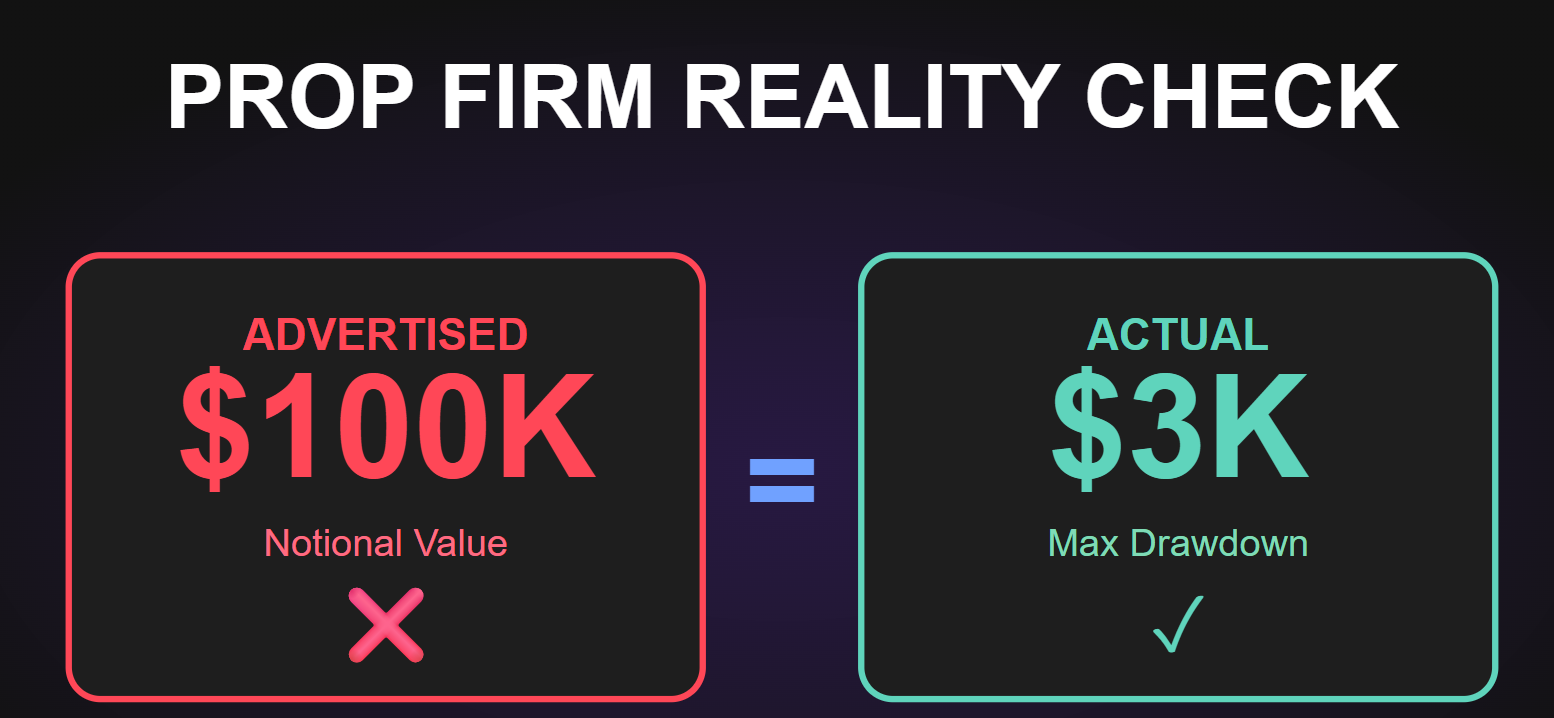
Scalable opportunity. You don’t need $100k sitting in your personal account. A few hundred dollars in evaluation fees can give you access to six figures of trading capital.
Prop firms are giving ambitious traders the chance to trade like professionals without risking their financial future. And in a world where speed, discipline, and access to capital matter, that is a real edge.
The Bottom Line
Prop trading is the bridge between skill and opportunity. If you have a solid strategy but not deep pockets, or you want to limit your downside while still chasing upside, a funded trading account makes sense.
So don’t think of the restrictions as barriers. Think of them as guardrails that keep you in the game long enough to actually win.
And if you want to do prop trading the right way, grab my free ebook here: TradersDevGroup.com/e-book
FAQs
1. How difficult is prop trading?
2. Are banks banned from prop trading?
3. What is the difference between a prop trader and a retail trader?
4. How do payouts work in prop trading?
Related Reads
Multi-Prop Trading Explained: The Simple Way to Scale with Multiple Fun
Inside the Evolution of Futures Prop Trading: A Conversation with Erik Schmitz of NexGen Futures
Commodity Futures Trading Commission. Futures and Options trading has large potential rewards, but also large potential risk. You must be aware of the risks and be willing to accept them in order to invest in the futures and options markets. Don’t trade with money you can’t afford to lose. This is neither a solicitation nor an offer to Buy/Sell futures or options. No representation is being made that any account will or is likely to achieve profits or losses similar to those discussed on this web site. The past performance of any trading system or methodology is not necessarily indicative of future results.
CFTC RULE 4.41 – HYPOTHETICAL OR SIMULATED PERFORMANCE RESULTS HAVE CERTAIN LIMITATIONS. UNLIKE AN ACTUAL PERFORMANCE RECORD, SIMULATED RESULTS DO NOT REPRESENT ACTUAL TRADING. ALSO, SINCE THE TRADES HAVE NOT BEEN EXECUTED, THE RESULTS MAY HAVE UNDER-OR-OVER COMPENSATED FOR THE IMPACT, IF ANY, OF CERTAIN MARKET FACTORS, SUCH AS LACK OF LIQUIDITY. SIMULATED TRADING PROGRAMS IN GENERAL ARE ALSO SUBJECT TO THE FACT THAT THEY ARE DESIGNED WITH THE BENEFIT OF HINDSIGHT. NO REPRESENTATION IS BEING MADE THAT ANY ACCOUNT WILL OR IS LIKELY TO ACHIEVE PROFIT OR LOSSES SIMILAR TO THOSE SHOWN.