
A question I get all the time, and why the concern is misplaced
A recent reply to an email I sent got this response:
“I know you’ve recommended trading the Dow micro MYM. Is there any problem because it’s only averaging 118,000 contracts a day?”
I get some version of this question frequently, and I completely understand where it’s coming from. Here’s the thing though — it’s the wrong thing to worry about. Let me explain why.
First, Let Me Acknowledge the Apparent Contradiction
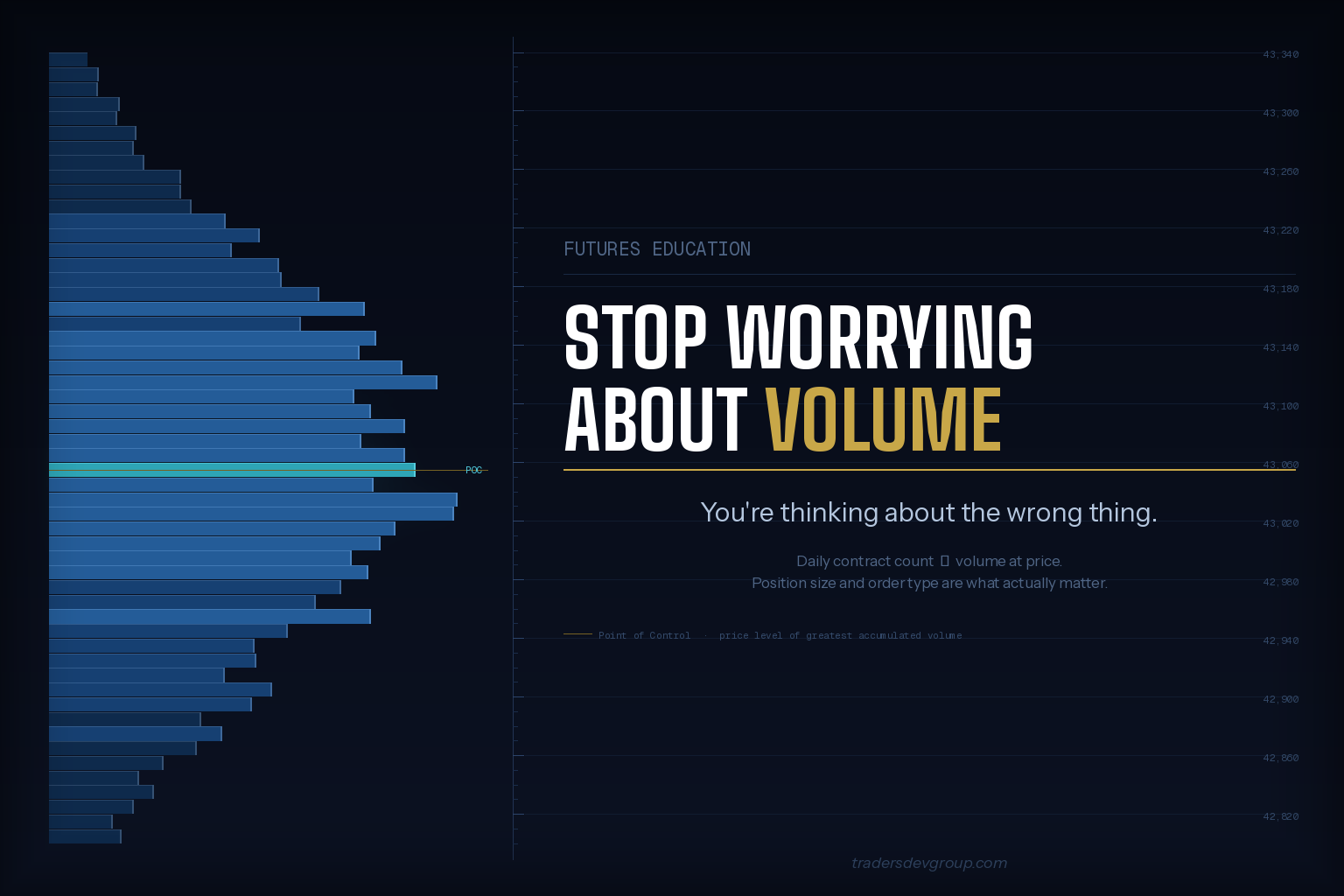
I talk about volume all the time. Volume and volatility are the two most important things to understand about how markets actually behave. At TDG, we use a 7-day ATR to measure volatility, and for volume we look at a volume histogram on a 30-minute chart, what’s often called volume at price.
That is not the same thing as how many contracts trade in a day.
Volume at price tells you where real trading activity is concentrated in a price range, where buyers and sellers are actually doing business. That’s meaningful. Daily contract count? For what we’re doing, it mostly isn’t. Here’s why.
Reason 1: You’re (Probably) Not Trading Real Money Yet
If you’re newer to my content, or newer to futures in general, you should be trading on a simulator, either a personal sim or, more likely, a simulated account through a prop firm. In a simulated environment, execution is not affected by actual market volume. Whether the MYM trades 118,000 contracts a day or 10 million, your simulated fills work the same way. The simulators are good. This concern simply doesn’t apply.
Reason 2: We’re Not Trading That Much Size
Even when you do go live, we’re not talking about moving markets here. Compare the MYM at roughly 118,000 contracts a day to the MNQ (micro NASDAQ), which trades around 2 million contracts a day. That sounds like a massive gap — and in absolute terms, it is.
But in practical terms? For a trader putting on 1, 2, or even 5 contracts? There is no meaningful difference. You are not the variable affecting liquidity in either of those markets. The size we’re operating at is a drop in the bucket either way.
Reason 3: We’re Using Limit Orders
This is probably the most important point. We’re not blasting market orders into thin books. We’re using limit orders, almost always. That changes the entire conversation.
When you enter with a limit order, you’re not a taker of liquidity, you’re a provider of it. What actually matters in that scenario is the spread and what’s sitting on the bid and ask. And even for the micros, even with a relatively thin book, that is simply not a practical issue for the size we’re trading.
The spread on the MYM is one tick. You’re not getting slipped out of your position because of “low volume.”
Where This Fear Actually Comes From
I think most of this concern comes from sound advice in a completely different context: the stock market.
In equities, low-float, low-volume stocks are legitimately dangerous. They’re easy to manipulate, spreads can be wide, and exits can be brutal. If you’ve spent any time learning stock trading, you’ve probably been told to stay away from illiquid names, and that’s good advice for stocks.
But futures don’t work the same way. These are centralized, regulated, standardized contracts. The MYM is a CME product. Applying stock market liquidity anxiety to futures contracts — especially the micros — is a category error.
The Bottom Line
Volume at price on a 30-minute chart? Pay attention to that. It tells you where the market has been doing real business and helps you identify meaningful levels.
Daily contract count for the MYM? For what we’re doing, at the size we’re trading, using the order types we use, in the environments most of us are actually trading in right now, it’s not the variable to be watching.
The concern makes sense if you’re coming from stocks, but in this context, it just doesn’t apply. File it away and move on
Want to dig deeper into how we actually read volume and volatility in real market conditions? Come join the conversation in our trading community — drop your questions, share your charts, and learn alongside traders who are working through the same things you are.
[Join the Discord Community →]