I’ve been trading with futures prop firms for years now, and there’s something I need to clear up because I keep seeing misleading ads all over social media. Firms are advertising that you can “trade a $100K account” or “get funded with $50K” when that’s not really what you’re getting.
I’m not here to bash prop firms. They can be a great opportunity. But let’s talk honestly about what they’re actually offering so you can make informed decisions, especially if you’re still trying to understand what is a prop firm in trading from a practical standpoint.
What They Advertise vs. What You Actually Get
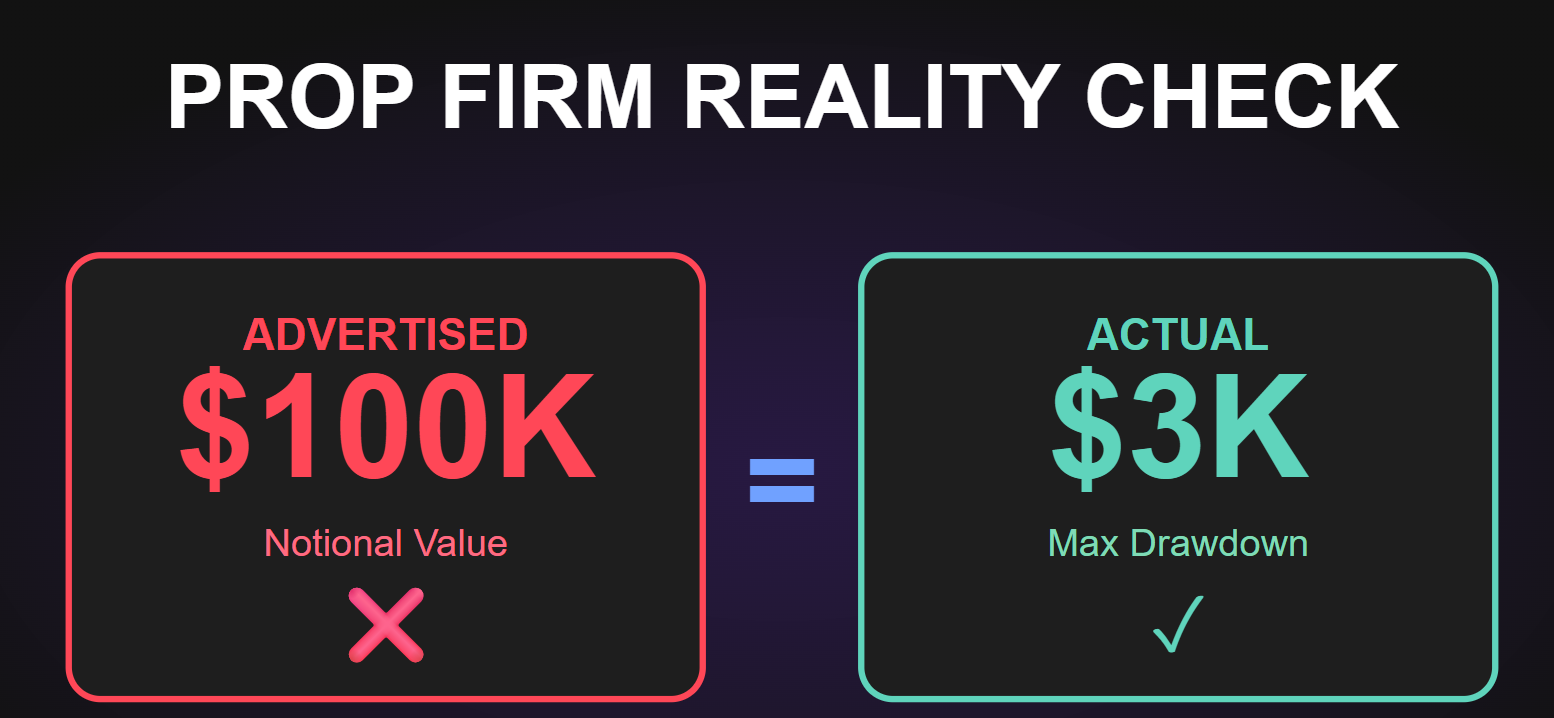
When you see those ads saying “Trade our $100K account!” what they’re not telling you upfront is that the real size of the account you’re trading is based on your maximum drawdown, not that big number they’re flashing at you. The conversation around prop firm account sizes becomes confusing because the real number comes from drawdown.
Here’s how it actually works, and this alone clears up a lot of confusion around what is a prop firm in trading in real-world terms. Most firms give you a drawdown limit of around $2,500 to $3,000. Some go up to $5,000 or $6,000 on their larger offerings. That drawdown amount? That’s your actual account size. That’s the capital you have to work with before you’re done.
Think about it. If you have a $100K account but can only lose $3K before you’re out, you’re not really trading a $100K account. You’re trading a $3K account. The moment you hit that drawdown limit, game over. It doesn’t matter if the notional value says $100K.
Why This Matters for Your Trading
Once you understand what you’re actually working with, a lot of things start to make sense. Those other rules that traders complain about? The daily loss limits, the consistency requirements, the contract restrictions? They’re not actually that unreasonable when you realize you’re trading a small account. These apply whether you’re in futures or looking into prop firm options trading, because the real risk is based on drawdown.
If you’re working with $2,500 to $3,000 in real terms, then of course there are going to be tighter rules. You need to adjust your position sizing, your risk per trade, your expectations accordingly based on real capital and current market conditions. The rules become totally manageable once you recalibrate to the actual account size.
The problem is when traders think they’re trading a massive account and they size their trades for $100K of capital. That’s when people blow up and get frustrated.
The Real Opportunity (And It’s Still Good)
Here’s what prop firms should be promoting instead. Many of them let you run multiple accounts at the same time. Some firms allow 10, 15, even 20+ prop firm accounts, which dramatically expands your working capital. They even provide copiers that let you place the same trade across all of them simultaneously, making trade copying a core part of how traders scale.
So instead of saying “Trade our $100K account,” they should be saying “Trade five $2,500 accounts for a total of $12,500 in working capital.” That’s still a great deal. Most traders don’t have $12,500 to risk in their personal trading accounts. Getting access to that kind of capital for a few hundred bucks in evaluation fees is valuable.
When you frame it that way, it’s honest and it’s still attractive. You’re getting real leverage on your money. You’re not risking your own capital. You can scale up by adding more accounts as you prove yourself. That’s the actual value proposition once you really grasp what is a prop firm in trading and how these programs structure risk.
Want to learn the complete system for succeeding with prop firms? I’ve put together everything I’ve learned from years of trading these programs in my free eBook, Prop Done Right. It covers the strategies, mindset shifts, and practical approaches that actually work.
How The Industry Should Change
There are firms doing this more honestly. The Futures Desk, for example, lists the actual account value based on what you can actually trade with. They’re transparent about the drawdown being your real working capital. More firms should follow that model, particularly as more traders explore prop firm options trading and expect transparency about real capital.
The current marketing approach where everyone emphasizes the notional value creates unrealistic expectations for traders entering the financial markets. It sets traders up to fail because they’re thinking about risk and position sizing all wrong from day one.
What You Should Know Before Starting
If you’re looking at prop firms, here’s my advice:
Look at the drawdown limits, not the advertised account size. That drawdown is your real capital.
Adjust your trading strategy for a small account. Because that’s what you’re actually trading.
Consider the multi-account option, because managing multiple prop firm accounts can be a powerful scaling method. If a firm lets you run multiple accounts with trade copiers, that’s where the real scaling happens when trade copying allows consistent execution across all prop firm accounts.
Don’t get caught up in the big numbers. Focus on the actual terms and whether they work for your trading style, your risk tolerance, and the market conditions you’re trading in.
Most firms start you in simulation until you hit profit targets, then move you through some payout milestones before you can convert to live capital. That’s fine. Just know what you’re signing up for.
How to Use Prop Firm Accounts Wisely in Today’s Financial Markets
Prop firms, or Funded trading companies can be a great opportunity for traders who don’t have significant capital to participate in the financial markets. They do give you leverage and a shot at trading with more money than you’d have access to otherwise.
But the marketing needs to be straight with people. You’re not trading a $100K account. You’re trading a $2,500 to $3,000 account, maybe up to $6,000 on the high end. And honestly? That’s still a good deal when presented correctly.
The firms that are transparent about this will build more trust, have more successful traders, and create better long-term relationships. Everyone wins when expectations match reality from the start.